How Your Construction Bookkeeper Helps You Work With Your CPA — Not Replace Them

By Tammy Hoang, QuickBooks ProAdvisor | Construction Cost Accounting | calendly.com/tammycca/30min
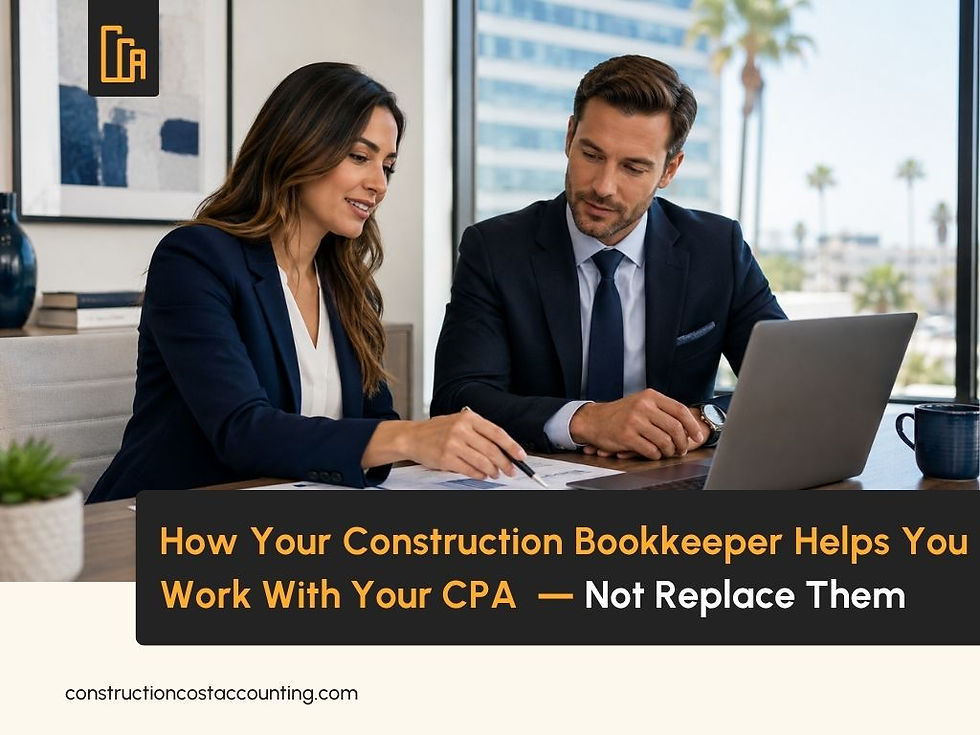
Every construction owner I work with has a CPA. What most of them do not have is a construction bookkeeper who makes that CPA relationship actually work. Here is what I mean. Your construction CPA is a tax professional. Their job is to prepare your tax returns, minimize your tax liability, advise on entity structure, and represent you if the IRS ever comes knocking. They are essential. But a construction CPA can only do their job well if the financial data they receive is accurate, organized, and delivered on time. That is where construction bookkeeping comes in. A bookkeeper for contractors is not a replacement for your CPA — they are the system that makes your CPA effective. Clean books mean a faster tax return due date turn around. Accurate job cost accounting means your CPA is filing on real numbers, not estimates. A monthly WIP schedule means your quarterly tax due date payments are based on actual profitability, not guesswork. This post explains exactly how your construction bookkeeper and your construction CPA are supposed to work together — and what happens to your construction accounting when they do not.
The Difference Between a Construction Bookkeeper and a Construction CPA
The confusion between what a bookkeeper does and what a CPA does costs construction owners time and money every year. Here is the clearest way to understand the distinction. Your construction bookkeeper handles the day-to-day and month-to-month financial operations of your business. This means recording every transaction by job and cost code, reconciling bank and credit card accounts, managing accounts payable and accounts receivable, producing monthly job cost accounting reports, running WIP schedules, tracking retainage, and keeping your books current all year long. Your construction CPA handles the annual compliance and strategic tax work. This means preparing your federal and California state tax returns, advising on your entity structure, reviewing your financial statements for tax accuracy, handling depreciation elections, and advising on your quarterly tax due date obligations for estimated payments. The bookkeeper works year-round. The CPA works intensively during tax season and at key decision points during the year. Neither role replaces the other. A construction CPA who receives disorganized books every March is spending their billable time cleaning up your costing accounting instead of doing tax strategy. A construction bookkeeper who has no relationship with your CPA is producing reports that may not match what the CPA needs. The most efficient construction accounting systems are the ones where both professionals are aligned.

What CCA Delivers to Your CPA — At Every Tax Deadline
The table below shows every major tax return due date and quarterly tax due date a construction contractor faces — and what CCA prepares for your CPA at each one.
Tax Deadline | What CPA Needs | What CCA Delivers |
Q1 — April 15 | Quarterly estimated tax payment | Accurate P&L through March 31, job cost summary |
Q2 — June 15 | Quarterly estimated tax payment | Updated WIP schedule, AP/AR reconciliation |
Q3 — Sept 15 | Quarterly estimated tax payment | Mid-year job profitability report, cash flow summary |
Q4 — Jan 15 (next yr) | Quarterly estimated tax payment | Year-to-date financials, retainage balances |
Tax Return — March 15 (S-Corp/Partnership) | All financials for prior year | Clean P&L, balance sheet, WIP, job cost reports, depreciation schedule |
Tax Return — April 15 (Sole Prop/LLC) | All financials for prior year | Same package — delivered by February at CCA |
When your books are current every month, these deadlines are not emergencies. Your CPA receives a clean package, files accurately, and advises on estimated payments based on real job cost accounting numbers — not last year's projections.
5 Specific Ways CCA Helps Your Construction CPA Do Their Job
Here is how construction bookkeeping directly supports your construction CPA relationship in practice. First, clean books eliminate CPA cleanup fees. When your CPA receives disorganized or incomplete records, they spend time — at CPA rates — sorting out the basics before they can even start the tax return. CCA delivers a reconciled, organized set of books every month so that when your CPA opens your file at tax time, the construction accounting is already done. They go straight to tax strategy, not data entry. Second, job cost accounting provides the real income picture. A construction business does not have simple income — it has revenue spread across dozens of jobs at different stages of completion. A bookkeeper for contractors who runs proper job cost accounting gives your CPA a true picture of what was earned, what was spent, and what margin each project actually produced. This is what accurate construction accounting requires. Third, WIP reporting supports correct revenue recognition. If your construction CPA is advising on your tax method — percentage of completion versus completed contract — they need a WIP schedule that shows where every job stands. CCA produces this monthly. Your CPA gets what they need to advise correctly. Fourth, quarterly tax due date planning becomes data-driven. Estimated tax payments are supposed to reflect your actual profitability for the quarter. When your costing accounting is current, your CPA can look at your actual job margins and make a real recommendation. When it is not current, they are guessing. Fifth, year end construction accounting becomes a non-event. When books are reconciled monthly, the year-end close is simply December's reconciliation. CCA delivers a complete year-end package — P&L, balance sheet, WIP schedule, job cost summary, retainage balances, depreciation schedule — ready for your CPA by early February. No scrambling. No extensions because the books were not ready.

What Happens When Bookkeeper and CPA Are Not Coordinated
The most common version of this problem I see in Orange County construction accounting is the contractor who uses a general bookkeeper — someone who does basic data entry but has no construction background — and a construction CPA who gets whatever the bookkeeper produces. The CPA then has to reconcile job cost accounting that does not match the contracts, WIP reports that were never run, and quarterly tax due date payments that were made based on bank balance rather than actual profitability. The result is a tax return that takes longer, costs more in CPA fees, and is often filed on extension because the books were not ready. The second common version is the contractor who does their own bookkeeping throughout the year and then brings everything to their CPA in March. The construction CPA spends the first part of every engagement cleaning up twelve months of transactions instead of doing tax work. This is one of the most expensive ways to run construction accounting. The third version — and the one that works — is a dedicated bookkeeper for contractors who maintains current books all year, produces monthly job cost accounting reports, runs quarterly WIP schedules, and delivers a complete year-end construction accounting package to the CPA by February. The CPA does their job. The bookkeeper does their job. The contractor pays appropriate fees for each and gets the full value of both.
Is Your Construction Bookkeeper Helping Your CPA — or Creating More Work?
If your construction CPA is spending time cleaning up your books each spring, that is not a CPA problem — it is a construction bookkeeping problem. CCA provides construction bookkeeping for contractors throughout Orange County and across California. We maintain current, accurate books every month, produce job cost accounting reports and WIP schedules that your construction CPA can rely on, and deliver a complete year-end construction accounting package so your tax return due date is never a scramble. We work alongside your CPA — not instead of them. This bookkeeper CPA collaboration is what keeps your construction accounting running efficiently all year, and what makes year end construction accounting a non-event instead of a crisis. Bookkeeper CPA collaboration done right means your CPA opens your file in March and spends their time on tax strategy — not cleanup. If you want your bookkeeper for contractors to be the system that makes your construction CPA relationship work, book a free 30-minute consultation with Tammy. Call (949) 482-2790 or schedule directly below.

Frequently Asked Questions — Construction Bookkeeper and CPA Coordination
What is the difference between a construction bookkeeper and a construction CPA?
A bookkeeper for contractors handles day-to-day and month-to-month construction bookkeeping — recording transactions by job and cost code, reconciling accounts, running WIP schedules, and producing job cost accounting reports all year. A construction CPA handles annual tax compliance — preparing tax returns, advising on entity structure, and managing quarterly tax due date planning for estimated payments. They are different roles that work best when coordinated. CCA handles the bookkeeping side so your construction CPA can focus on tax strategy.
How does a construction bookkeeper help with tax preparation?
A bookkeeper for contractors who maintains current construction bookkeeping throughout the year delivers clean, reconciled financials to your construction CPA before the tax return due date — no scrambling, no cleanup fees. CCA provides a complete year-end construction accounting package including P&L, balance sheet, WIP schedule, job cost accounting summary, retainage balances, and depreciation schedule ready for your CPA by early February.
What is the quarterly tax due date for construction contractors?
For most construction contractors, quarterly estimated tax payments are due April 15, June 15, September 15, and January 15 of the following year. These quarterly tax due date payments should be based on your actual year-to-date profitability — which requires current construction bookkeeping and job cost accounting data. CCA provides updated financials before each quarterly tax due date so your construction CPA can advise on the correct payment amount.
What is costing accounting in construction?
Costing accounting in construction — also called job cost accounting — is the process of tracking every dollar of cost by job and cost code. This includes labor, materials, subcontractors, equipment, and overhead allocated to each specific project. Accurate costing accounting is the foundation of construction bookkeeping and provides your construction CPA with the real income picture needed to prepare an accurate tax return.
Does CCA work with my existing CPA?
Yes. CCA works alongside your existing construction CPA — we do not replace them. We maintain your construction bookkeeping, produce job cost accounting reports and WIP schedules monthly, and deliver a clean year-end construction accounting package your CPA can rely on. If you do not have a construction CPA, we can refer you to construction-specialized CPAs in Orange County we have worked with. Effective bookkeeper CPA collaboration and year end construction accounting preparation are what CCA was built to deliver. Call (949) 482-2790 or book at calendly.com/tammycca/30min. Bookkeeper CPA collaboration starts the moment your books are current — and year end construction accounting stops being a problem the moment we take over the books.


Comments