Uninstalled Materials Under ASC 606: The Percentage-of-Completion Rule Contractors Miss (2026)

By Tammy Hoang, QuickBooks ProAdvisor — Construction Bookkeeping Specialist | Construction Cost Accounting
(949) 889-3283 | constructioncostaccounting.com
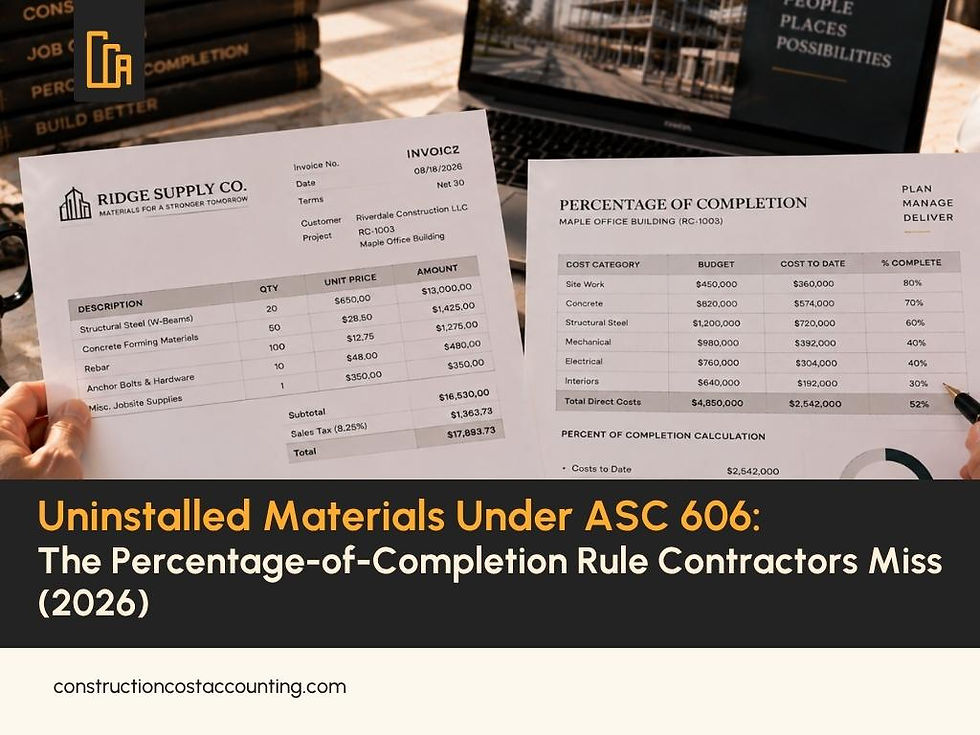
Direct answer: under ASC 606, materials delivered to a job site but not yet installed must generally be excluded from the cost-to-cost calculation used to measure percentage of completion, and revenue equal to their cost — with no profit margin — is recognized separately until installation occurs. Skipping this carve-out overstates a job's true percentage complete. Construction bookkeeping needs a process to catch this every reporting period, not just at year-end.
This guide covers what the uninstalled materials rule requires and what construction cost accounting should track to apply it correctly. This is general information, not accounting advice — confirm treatment of specific contracts with your CPA.
1. Why a Large Material Delivery Can Distort Your Numbers

The cost-to-cost method measures percentage complete by dividing costs incurred to date by total estimated cost. A large material purchase — custom equipment, specialty millwork, bulk HVAC units — delivered to the site but sitting uninstalled inflates the numerator without reflecting real progress, which is exactly the distortion ASC 606-10-55-189 and 55-190 were written to prevent.
THE UNINSTALLED MATERIALS RULE UNDER ASC 606
A specific carve-out most percentage-of-completion explainers skip past
The problem it solves | A large material purchase delivered but not yet installed can artificially inflate a cost-to-cost percentage-of-completion calculation, overstating how far along a job actually is |
The exclusion | Under ASC 606-10-55-189 and 55-190, uninstalled materials controlled by the customer are excluded from the costs used to measure progress toward completion |
The zero-profit carve-out | Revenue equal to the cost of the uninstalled materials is still recognized — but with no associated profit margin — until the materials are actually installed |
When it applies | Generally when the contractor is acting as principal in procuring the materials and the customer controls them, per the related guidance in ASC 606-10-55-36 through 55-40 |
Source: FASB ASC 606-10-55-189, 55-190, 55-36 through 55-40. Construction Cost Accounting | constructioncostaccounting.com
⚠ RED FLAG: Contracts with material-intensive scopes — specialty trades, custom fabrication, large equipment installs — carry the most real risk here. A contractor who buys materials well ahead of installation and includes the full cost in their percent-complete calculation without applying this carve-out can significantly overstate progress and revenue for that reporting period. |
2. How the Carve-Out Actually Works in Practice

The mechanics: identify costs incurred for materials that haven't been installed, carve those costs out of both the numerator and denominator of the percentage-complete calculation, then separately recognize revenue equal to the uninstalled materials' cost — at zero margin — once the customer controls them. Construction bookkeeping should track uninstalled material costs as their own category on every material-intensive job, updated each reporting period as materials move from delivered to installed.
OWNER'S TAKEAWAY: On any job with a significant material delivery ahead of installation, tag that cost as "uninstalled" in your job cost system the moment it hits the books. Move it to installed cost only once it's actually in place — that tag is what makes the ASC 606 carve-out calculation possible without reconstructing records at reporting time. |
Is Your WIP Schedule Catching Uninstalled Materials?
Many contractors with material-intensive contracts never apply this carve-out, quietly overstating percent-complete on jobs with big early deliveries. CCA builds bookkeeping that tracks it correctly. In a free 30-minute review, we'll show you where your WIP schedule stands.
constructioncostaccounting.com | (949) 889-3283
3. Who This Actually Affects Most

This carve-out matters most for contractors whose contracts involve significant, discrete material purchases ahead of installation — mechanical, electrical, and plumbing trades ordering major equipment early, custom millwork and fabrication shops, and general contractors procuring owner-specified fixtures well before the relevant phase of work. Construction cost accounting for these trades should build this review into every monthly WIP close, not treat it as a rare exception.
A percentage-of-completion number that includes uninstalled materials at full margin isn't showing real progress — it's showing how much you've spent on things sitting in a warehouse. The carve-out exists because those aren't the same thing. |
4. The Reports a Material-Intensive Contractor Needs
Pulling this together, here's what a contractor with material-intensive contracts should track:
Uninstalled material costs tagged separately — by job, updated each reporting period as materials get installed
Percent-complete calculated with the carve-out applied — numerator and denominator both excluding uninstalled material cost
Zero-margin revenue tracked for uninstalled materials — recognized at cost only, until installation
Monthly WIP schedule review — checking for this distortion on every material-intensive job, not just at year-end
With those in place, a contractor's percentage-of-completion numbers reflect real progress, not inventory sitting on-site. That's construction accounting doing its job on a specific ASC 606 mechanic most general revenue recognition guides skip past.
Where Construction Cost Accounting Fits In

Construction Cost Accounting provides construction bookkeeping services for contractors with material-intensive contracts who need the uninstalled materials carve-out applied correctly. For this, that means:
Uninstalled materials tagged and tracked — by job, from delivery through installation
Percent-complete calculated correctly — with the carve-out applied every reporting period
WIP schedules that hold up to review — clean enough to withstand a surety or lender's scrutiny
A construction bookkeeper who understands ASC 606's specifics — construction bookkeeping services built around the mechanics, not just the headline concept
We work with contractors in material-intensive trades who need percentage-of-completion calculated correctly, uninstalled materials included. Our construction bookkeeper team — experienced in construction accounting for material-intensive trades — tags and tracks these costs every reporting period — so your WIP schedule reflects real progress. That's results-based construction bookkeeping for contractors managing this exact ASC 606 nuance.
Get Your Percent-Complete Calculation Right
CCA builds construction bookkeeping around correct uninstalled materials tracking under ASC 606. Book a free 30-minute review and see where your books stand.
constructioncostaccounting.com | (949) 889-3283
The uninstalled materials rule under ASC 606-10-55-189 and 55-190 is a specific, often-overlooked carve-out for contractors on material-intensive jobs. Exclude uninstalled material costs from your percent-complete calculation, recognize their cost as zero-margin revenue until installed, and review this every reporting period on jobs with significant early deliveries.
The contractors whose WIP schedules hold up to scrutiny aren't including uninstalled materials at full margin — they're the ones whose construction bookkeeping services apply this carve-out correctly, every period. For our full service, visit our construction bookkeeping page. CCA's construction bookkeeper team and construction accounting expertise give material-intensive contractors that foundation. Good bookkeeping for a material-intensive contractor starts with knowing the difference between materials on-site and progress actually made.


Comments