Job Costing in Construction — Definition, How to Calculate Total Job Cost, and Real Examples

By Tammy Hoang, QuickBooks ProAdvisor | Construction Cost Accounting | (949) 889-3283

Job costing is the most important accounting method in construction — and the one most often done wrong. When job costing is set up correctly and maintained monthly, a contractor knows exactly how much every active project has cost to date, how that compares to the original budget, and what the projected margin is at completion. When it is not set up correctly, a contractor knows their bank balance and not much else. Job costing in construction is the process of tracking every dollar of cost — labor, materials, subcontractors, equipment, and allocated overhead — to a specific project and a specific cost code within that project. It produces the job cost report: the financial document that tells you whether a project is on track or bleeding money before the problem becomes irreversible. The job costing definition is straightforward: assign every expense to the job and cost code where it belongs, compare actual costs to the budget throughout the project, and use the variance to make decisions. Job cost analysis — the comparison of budgeted to actual costs — is what separates a bookkeeper who tracks transactions from a construction bookkeeping specialist who manages project profitability. At Construction Cost Accounting, job costing accounting is the foundation of every client engagement. This guide covers the job costing definition, the total job cost formula with a complete worked example, how cost codes work in a construction job cost accounting system, and how to read the job cost analysis that tells you whether a job is still profitable.
Job Costing Definition — What It Is and What It Is Not
The job costing definition in construction accounting is the method of tracking costs at the individual project level — assigning every expense to a specific job so that the cost of completing that project is visible in total and by cost category. This is distinct from general bookkeeping, which tracks expenses at the company level. In general bookkeeping, you see total labor costs for the month. In job costing construction, you see labor costs by project, by cost code, and by week — so you know which job is using labor efficiently and which one is running over. Job costing definition extends to the output it produces: the job cost report, which compares estimated costs to actual costs to date and to the revised estimate at completion. This is the report that answers the most critical questions in construction financial management — is this job on budget, where are the variances, and what will the final margin be. What job costing is not: it is not process costing, which is used in manufacturing where identical units are produced repeatedly. Every construction project is unique — different site conditions, different labor productivity, different material quantities. Job costing is specifically designed for this reality. It is also not the same as the WIP schedule, though the two are closely related. The WIP schedule uses job costing data to calculate earned revenue under the percentage of completion method — the job cost report provides the cost inputs that the WIP schedule uses to calculate the financial position of each project. Job costing accounting that is maintained correctly produces a job cost report that can be directly used in the WIP schedule — reducing the manual reconciliation work at month-end and improving the accuracy of the revenue recognition calculation.
💡 Tammy's Tip: The job costing definition only matters if the system is maintained consistently. A job cost report that is two months behind — because invoices were not coded or subcontractor payments were not entered — is not a management tool. It is a historical record of a problem you can no longer solve. CCA maintains job costing for every client on a monthly close schedule so the report is always current. |
How to Calculate Total Job Cost — The Formula and Every Component
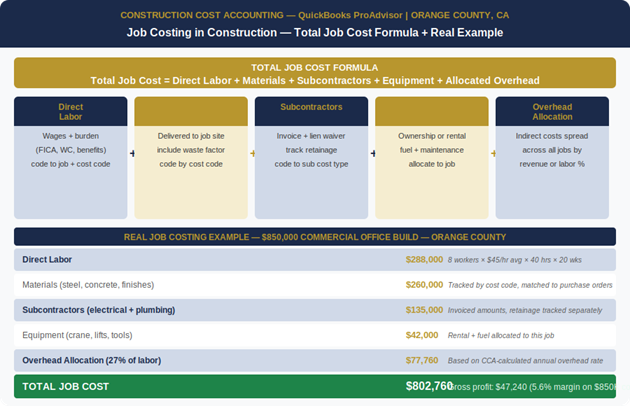
How to calculate total job cost in construction follows a single formula: Total Job Cost = Direct Labor + Materials + Subcontractors + Equipment + Allocated Overhead. Each component requires a specific approach to make the calculation accurate. Direct Labor is not simply the employee's wage rate. Direct labor in job costing construction must include labor burden — the employer's cost of FICA taxes, workers compensation insurance, general liability insurance, health benefits, and any other payroll-related costs. For most Orange County construction employers, labor burden adds 30 to 40 percent to the base wage rate. A carpenter earning $38 per hour costs the contractor $50 to $53 per hour fully burdened. If job costing accounting is tracking the $38 wage but not the burden, the labor cost on the job cost report understates the true cost by 30 to 40 percent — and the margin calculation is wrong before any other line item is reviewed. Materials must be coded to the job and to the specific cost code at the time of purchase — not at the time of delivery and not as a lump sum at month-end. A purchase order for steel delivered to Job 204 must post to Job 204, cost code 05-000, at the time the invoice is approved. If materials are entered to a general account and coded to a job later — or never — the job cost report will not reflect actual material spend until the correction is made. Subcontractor costs must include the gross invoice amount, and retainage withheld from the subcontractor must be tracked separately as retainage payable. The job cost report should show the full committed cost of each subcontractor — not just what has been paid — so that the cost-to-complete calculation reflects the actual financial obligation. Equipment costs must be allocated to the specific job where the equipment was used. When a piece of equipment — a crane, a excavator, a compressor — is used on multiple jobs in the same month, its cost must be allocated proportionally based on hours or days used on each job. Equipment costs that flow to general overhead instead of to specific jobs understate job costs and overstate overhead, which produces an incorrect overhead rate. Allocated overhead is the indirect cost component of how to calculate total job cost. The overhead allocation method — revenue-based, labor-based, or direct cost-based — determines how much of the company's general and administrative costs are assigned to each project. This allocation should be calculated from the annual overhead rate and applied consistently to every active job in the job cost accounting construction system.
💡 Tammy's Tip: The most common job costing error CCA corrects in new client accounts is missing labor burden. Contractors often track wage payments but forget to include the employer's share of FICA, workers compensation, and benefits in the job cost. This makes every job look more profitable than it actually is — until the year-end P&L reveals the true picture. Set up labor burden as a separate cost code or include it in the labor rate before the project starts. |

Cost Codes — The Foundation of Construction Job Cost Accounting
Cost codes are the categories within each job that allow construction job cost accounting to track not just how much a project has cost, but where the cost went. A job cost report without cost codes shows a single number — total cost to date. A job cost report with properly structured cost codes shows cost by trade, by phase, by cost type — which is the level of detail needed to identify variances, improve future estimates, and catch cost overruns before they compound. The Construction Specifications Institute — CSI — maintains a standardized cost code structure called MasterFormat that most construction accounting software systems, QuickBooks with construction add-ons, recognize and support. The most critical cost codes in a construction job costing system are listed in the table below, with the bookkeeping treatment that makes each one useful for job cost analysis.
Cost Code | Category | What Gets Coded Here | Job Costing Impact |
01-000 | General Conditions | Site supervision, temp facilities, safety | Shows true project management cost before first trade dollar is spent |
03-000 | Concrete | Formwork, rebar, pour, finish | Catches concrete overruns — the most common cost code variance |
05-000 | Structural Steel | Fab, delivery, erection | High unit cost — any quantity change has large budget impact |
16-000 | Electrical | Rough-in, devices, panel, service | Labor-intensive — labor burden must be included in budget |
23-000 | HVAC / Mechanical | Ductwork, equipment, controls | Subcontractor-dominated — track against committed cost |
Payroll | Labor with Burden | Wages + FICA + WC + benefits | Labor burden (30–40%) must be included — not just the wage rate |
SUB | Subcontractor | All sub invoices + retainage | Retainage payable tracked separately from invoice total |
EQUIP | Equipment | Rental, fuel, maintenance per job | Prevent equipment costs from disappearing into general overhead |
💡 Tammy's Tip: In QuickBooks Online with job costing, cost codes are mapped to service items or classes. The key rule: a cost that is coded to the wrong job or wrong cost code cannot be used for accurate job cost analysis — it must be corrected before the month is closed. |
Is Your Job Costing System Set Up Correctly?
When you book a call with Tammy, you will see within 30 minutes exactly where your current job costing is leaving money on the table — and what it would take to fix it. CCA sets up and maintains construction job cost accounting for contractors throughout Orange County and California.
Call or Text: (949) 889-3283

Job Costing Examples — A Complete Worked Example with Budget vs Actual
The most useful job costing examples are the ones that show not just how to calculate total job cost, but how the job cost analysis reveals variances and affects the final margin. The example below is a commercial office build in Orange County — a real-world project type with realistic numbers for the Southern California market in 2026. Contract value: $850,000. Duration: 20 weeks. The table below shows the budgeted vs actual costs at project completion, the variance for each cost category, and the impact on the final gross margin.
Cost Category | Budgeted | Actual | Variance |
Direct Labor (incl. burden) | $288,000 | $312,500 | ⚠️ +$24,500 over — investigate |
Materials | $260,000 | $248,000 | ✅ +$12,000 under — favorable |
Subcontractors | $135,000 | $135,000 | ✅ On budget — matched committed cost |
Equipment | $42,000 | $47,200 | ⚠️ +$5,200 over — extra crane days |
Overhead Allocation | $77,760 | $77,760 | ✅ Fixed — rate applied as planned |
TOTAL JOB COST | $802,760 | $820,460 | ⚠️+$17,700 — gross margin drops to 3.6% |
This job costing example illustrates exactly why job cost analysis matters. The project looked profitable at the bid stage — $850,000 contract with $802,760 in budgeted costs produces a 5.6% gross margin of $47,240. But the actual job cost of $820,460 — driven by a $24,500 labor overrun and $5,200 in additional equipment costs — reduces the gross margin to $29,540, or 3.6%. That difference — $17,700 — is the cost of not catching the labor overrun early. In construction job cost accounting, labor variances are almost always the first warning sign of a job going over budget. In this example, the labor overrun of $24,500 appeared across weeks 14 through 18 in the weekly cost reports — but if the job cost report was only reviewed monthly, the overrun was already $24,500 before any action was taken. CCA produces job cost reports weekly for active projects and monthly for all projects, which is the cadence that allows variances to be caught and corrected rather than just documented. The job costing construction system only produces this level of insight if every cost is entered, coded correctly, and reviewed on schedule. Construction bookkeeping that does not include monthly job cost reporting is missing its most important function. A job cost report that is two months behind is not a management tool — it is a historical record of margin erosion.
Job Costing in QuickBooks — How CCA Sets It Up
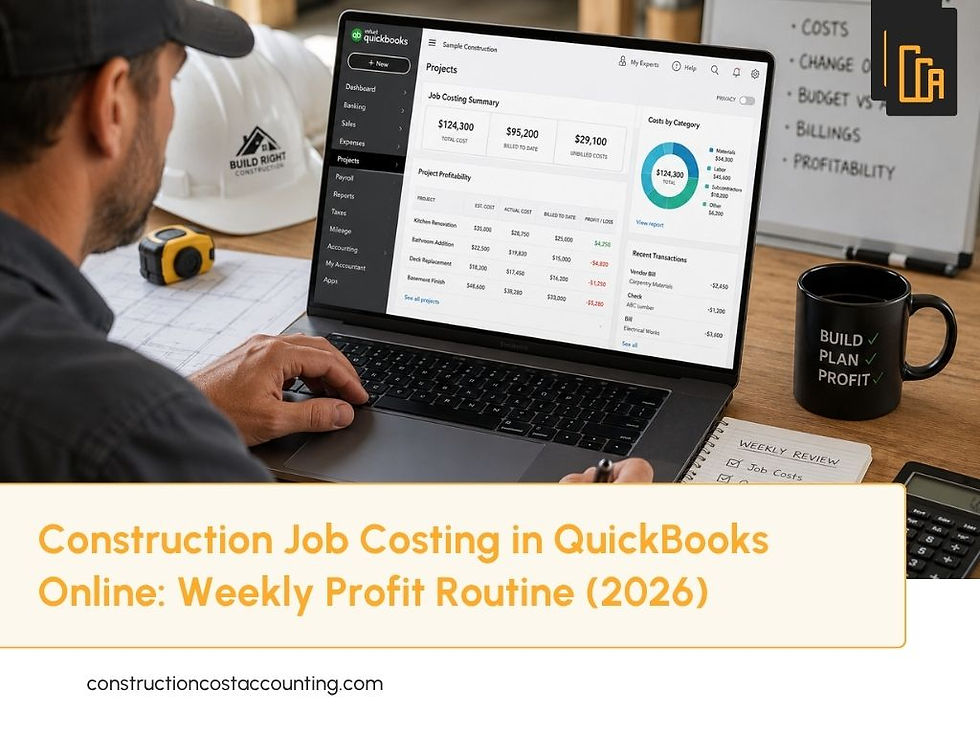
Construction job costing accounting requires software that is built for project-level cost tracking — not general business accounting software adapted for construction use. There are two systems CCA works with most frequently for construction job cost accounting: QuickBooks Online with job costing enabled uses the Customer or Project feature to assign expenses to jobs. Each job is set up as a customer or sub-customer, and every expense transaction — AP bill, check, payroll journal entry — must be assigned to the correct customer or project to appear on the job cost report. This requires discipline in the bookkeeping process: expenses entered without a customer assignment do not appear on the job cost report and must be corrected manually. CCA configures QuickBooks job costing for new clients with a proper chart of accounts, class structure, and cost code mapping — and we review the job cost report monthly to catch any transactions that were entered without a job assignment. QBO how to calculate total job cost from the bottom up — every transaction coded correctly rolls up into an accurate job cost report without manual re-entry or spreadsheet reconciliation.
Your Job Cost Report Should Tell You Something You Do Not Already Know
A job cost report that confirms what you already knew is not a management tool — it is a confirmation exercise. The value of construction job cost accounting is the early warning: the labor variance in week 14 that is caught before it becomes a $24,500 problem at completion, the subcontractor invoice that was miscoded to the wrong job and inflated one project's cost while deflating another's, the equipment allocation that was missing from a job's cost-to-complete because nobody tracked the days the crane was on site. Job costing in construction, done correctly, gives contractors the financial visibility to make decisions — not just to document them. Construction Cost Accounting provides job costing accounting setup, monthly maintenance, and job cost analysis for contractors throughout Orange County and California. We work in QuickBooks, produce weekly cost reports for active projects, maintain the WIP schedule, and catch variances before they reach your CPA. If you want your job costing construction system set up correctly and maintained by a construction bookkeeping specialist — Book your free 30-minute consultation with Tammy now — before another month passes with job costs that are not telling you the full story. Call (949) 889-3283 or schedule directly below and discover exactly what your job cost analysis would show if every number was captured correctly. Contractors who get their job costing construction system right stop guessing at margins and start managing them.
Book a Free Job Costing Consultation With Tammy
Construction Cost Accounting | Orange County, CA | (949) 889-3283
Call or Text: (949) 889-3283


Comments