Construction Job Costing in QuickBooks Online: The Weekly Routine That Keeps Jobs Profitable (2026)

By Tammy Hoang, QuickBooks ProAdvisor — Construction Bookkeeping Specialist | Construction Cost Accounting
(949) 889-3283 | constructioncostaccounting.com
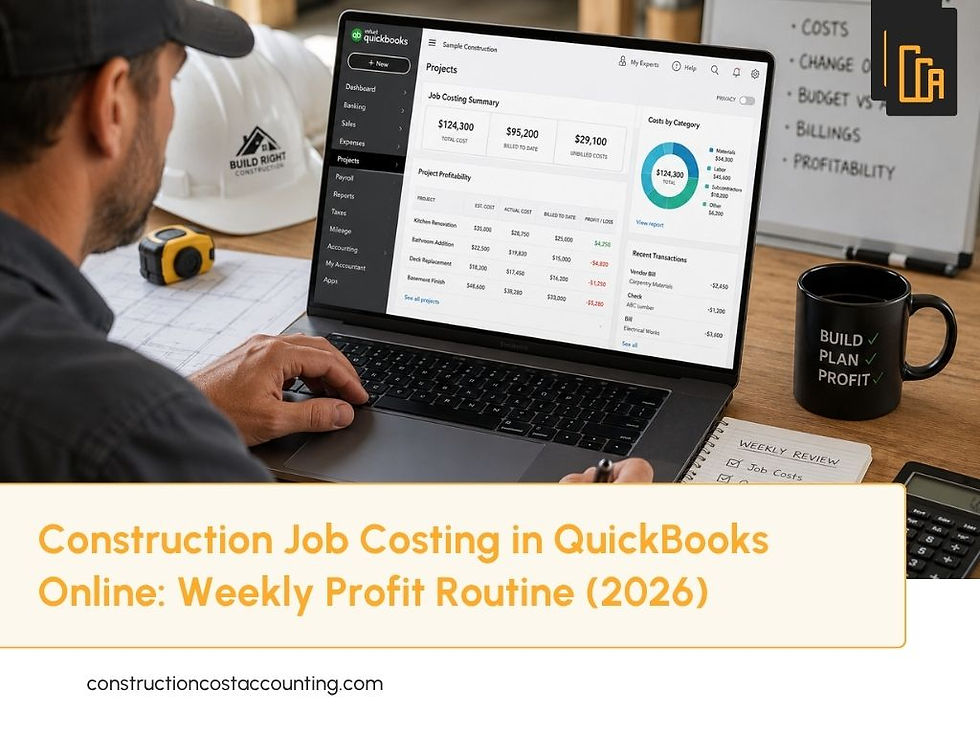
Most contractors who lose money on a job don't find out until the job is closed — when it's too late to do anything but absorb it. The fix isn't more software or a fancier setup. It's a routine. Construction job costing in QuickBooks Online only protects your margins if you actually run it — week in, week out — catching mis-coded hours, supplier billing errors, and budget overruns while there's still time to act. This guide is the operating routine: what to check, when, and what to do when a number looks wrong.
If you haven't set up job costing in QBO yet, start with our setup guide covering the three methods — sub-customers, classes, and the Projects feature — and our QuickBooks Online job costing tips for labor, materials, and overhead. This post assumes the system exists. Here's how to drive it.
1. Start at the Estimate, Not the First Invoice
The routine starts before the job does. Every project gets a unique job in QBO the day the estimate is built — not the day the first bill arrives — with a budget entered per cost category. That budget is what every weekly check compares against; without it, your job costing reports show what you spent but not whether it's on track, which is only half the answer.
Keep the cost code structure identical across all jobs. When every project uses the same categories, you can compare job to job, spot patterns, and — the long-term payoff — use your own history to sharpen future bids. Your past jobs are the best estimating database you'll ever have, but only if they're coded consistently enough to compare.
OWNER'S TAKEAWAY: A budget per cost category at the estimate stage is what turns QuickBooks Online from a record of what happened into a warning system for what's about to. Every weekly check below depends on it. |
2. The Weekly Routine
Here's the operating rhythm — roughly an hour a week, and it's the highest-return hour in construction bookkeeping:
THE WEEKLY JOB COSTING ROUTINE IN QUICKBOOKS ONLINE
About an hour a week — the habit that catches overruns while you can still fix them
Monday — Labor Check | Last week's hours in, coded to the right jobs, burden included — actual vs estimated hours per job |
As Delivered — PO Match | Match every supplier invoice to its purchase order before approval — catch errors and double-bills |
As Received — Sub Invoices | Verify work is complete and matches contract scope before approving; log change orders same day |
Friday — Cost to Complete | Review spent vs remaining per job; flag any cost category running over budget |
Monday — the labor check.
Labor is typically the largest variable cost on a construction job — commonly a quarter to 40% of total project cost — and it's the hardest to claw back once it runs over. The weekly check is simple: last week's hours are entered, coded to the correct job, and compared against estimated hours per job. Fifteen minutes here can save thousands, because labor overruns compound silently — by the time a monthly review catches them, you've had four more weeks of the same leak.
Two details make or break the labor number. First, mis-coded time: an employee logging hours to Job A instead of Job B makes one job look under budget and the other over — and every decision built on either number is wrong. Make it easy for the field to code time correctly (mobile time tracking that links hours to QBO projects helps enormously) and review entries weekly, not months later. Second, labor burden: the true cost of an hour isn't the wage — it's wage plus payroll taxes, workers' compensation, and benefits. Many contractors underestimate burden significantly, which means every job's labor cost is understated and every bid built on it is too thin. Your QBO labor costing should carry the fully burdened rate.
⚠ RED FLAG: If your job cost reports show wages without burden, every job looks more profitable than it is — and the error is invisible because it's consistent. Underestimating labor burden is one of the most common silent margin killers in construction bookkeeping — and fixing the labor burden rate fixes every job at once. |
As deliveries arrive — the PO match.
Purchase orders feel like paperwork until the first billing dispute. A PO is your documented record of what you agreed to pay — and matching every supplier invoice against its PO before approval is how you catch double-billing, price discrepancies, and charges for back-ordered materials that never arrived. In QBO, entering POs also gives you committed costs visibility: money you've agreed to spend but haven't been billed for yet, which is what makes a cost-to-complete picture realistic instead of optimistic. When an invoice doesn't match its purchase order, don't approve it and move on — that gap is money out of your pocket.
As they arrive — subcontractor invoices and change orders.
Subs aren't a fixed cost once the contract is signed. Track each sub as its own cost category per job, and keep a simple running log: contract value, approved changes, billed to date, remaining. Before approving any sub invoice, verify the work is complete and matches the contract scope. And when a change order comes in, log it the same day — scope creep is where sub costs quietly outrun the budget, and a change order that lives in someone's email instead of QuickBooks Online doesn't exist as far as your job costing is concerned.
Friday — the cost-to-complete review.
The week closes with the report that matters most: cost to complete, per job — what you've spent, your committed costs still to be billed, and what remains to finish. A cost to complete number without committed costs is fiction. The practical trigger: any cost category running more than about 10% over budget gets attention now, not at month-end. That's the whole point of the routine — a 10% overrun caught in week three is a correction; caught at closeout, it's a loss. This weekly read of your job costing reports is where construction accounting stops being record-keeping and starts being management — real construction accounting in action.
OWNER'S TAKEAWAY: No report helps if it sits unread. The Friday cost-to-complete review is the single habit that separates contractors who catch problems from contractors who discover them. Put it on the calendar like a client meeting. |
Want This Routine Running Without Doing It Yourself?
CCA runs the weekly job costing routine for contractors inside QuickBooks Online — labor coded and burdened correctly, POs matched, subs tracked, cost-to-complete reviewed and flagged. You get the warning system without spending your week in QBO. Book a free 30-minute review and see what your jobs look like with real weekly visibility.
Call or Text: (949) 889-3283
3. Materials, Waste & the Variance That Tells the Truth
Material costs leak in quiet ways: shared inventory pulled across multiple jobs and coded to none of them, deliveries that don't match orders, and waste nobody measures. The routine fixes the first two — code shared materials to the jobs that actually consume them, and hold the PO-match line. Waste takes one more step: build a realistic waste factor into your estimates, then track variance against it. Variance is the honest number — it proves whether your waste assumptions are realistic, and a high-waste job often points to a site problem: materials stored badly or handled carelessly. Without variance tracking, waste just disappears into the materials line of your job costing reports and your estimates never improve.
The contractors who bid best aren't guessing better — they're reading their own history. Consistent cost codes, burdened labor, and tracked variance turn every finished job into a sharper estimate for the next one. |
Where Construction Cost Accounting Fits In
Construction Cost Accounting provides construction bookkeeping services built around exactly this routine. We're a QuickBooks ProAdvisor practice working exclusively in construction, and for QBO contractors that means:
The weekly routine, run for you — labor checked and coded, POs matched, subs logged, cost-to-complete reviewed every week
Fully burdened labor costing — payroll taxes, workers' comp, and benefits in every job's labor number, not just wages
Committed costs visible — POs and sub contracts in QBO so your cost-to-complete is realistic
Overruns flagged early — any category trending past budget raised to you while there's time to act
A construction bookkeeper who knows QBO — construction job costing in QuickBooks Online set up and operated the way the trade requires
We work with contractors who have QBO but not the weekly discipline — and that's not a knock; you're building, not bookkeeping. Our construction bookkeeper team runs the routine so every job has a current, burdened, honest number. That's what results-based construction bookkeeping services deliver: you make decisions on real numbers, every week.
Catch the Overrun While You Can Still Fix It
CCA runs construction job costing in QuickBooks Online as a weekly discipline — burdened labor, matched POs, tracked subs, and a cost-to-complete review that flags problems early. You build; we watch the numbers. Book a free 30-minute review.
Call or Text: (949) 889-3283
Construction job costing in QuickBooks Online isn't a setup task — it's a weekly habit. Budget every job at the estimate stage, check labor weekly with full burden, match every invoice to its PO, log sub change orders the day they land, and close each week with a cost-to-complete review that flags anything running past budget. An hour a week, and jobs stop surprising you at closeout.
For the QBO setup itself, see our guide to the three job costing methods. For deeper QuickBooks Online costing tips, see our tips guide. And for our full service, visit our construction bookkeeping page. Good job costing isn't the report — it's the routine of reading it in time to act. That's the discipline that keeps jobs profitable, and it's exactly what CCA's construction accounting delivers — construction bookkeeping services run by a construction bookkeeper who reads your numbers every week.


Comments