Concrete Contractor Bookkeeping 101: How to Track the Money on Every Pour (2026)
- Cost Construction Accounting

- Jul 20
- 7 min read
By Tammy Hoang, QuickBooks ProAdvisor — Construction Bookkeeping Specialist | Construction Cost Accounting
(949) 889-3283 | constructioncostaccounting.com
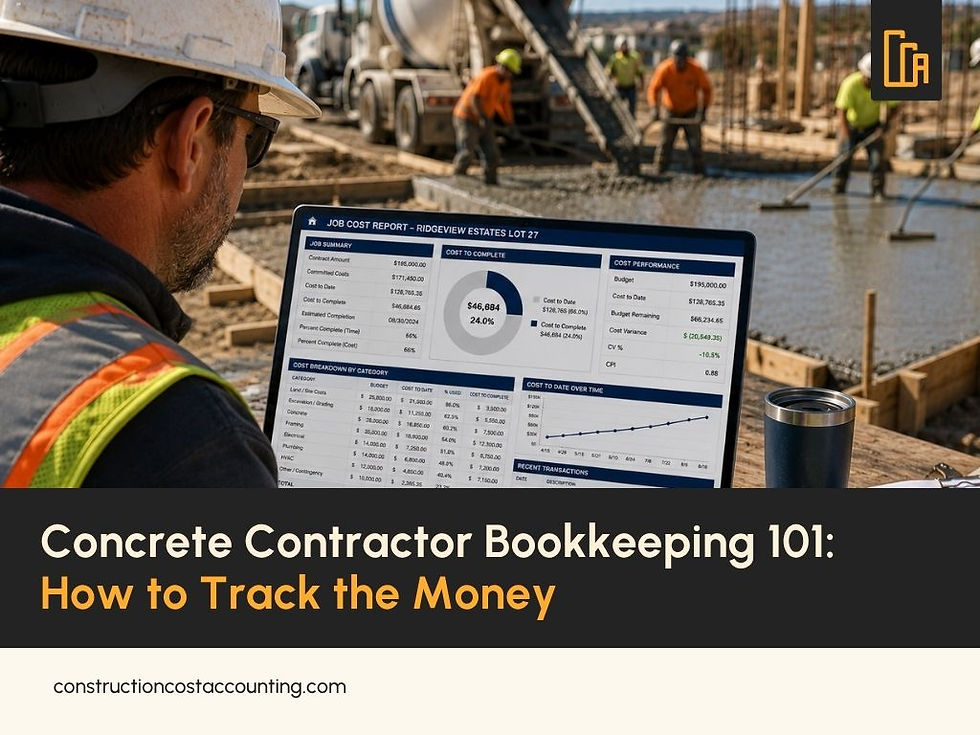
Concrete is one of the most unforgiving trades to run the books for. Your margins are thin, your material costs move with the market, a short load or an over-pour eats your profit on the spot, and if you touch public work you're likely dealing with prevailing wage on top. Concrete contractor bookkeeping isn't generic bookkeeping with a concrete label — it's a job-by-job, pour-by-pour discipline, and getting it wrong is the difference between a pour that made money and one that quietly lost it.
This is a plain-English guide to concrete bookkeeping for owners — how the money actually flows on a concrete job, what to track, and where concrete contractors lose margin without seeing it. The goal is to show you what good construction bookkeeping looks like for a concrete business, so your next job runs on numbers you can trust.
WHAT THIS GUIDE COVERS 1. Why Concrete Bookkeeping Is Different 2. The 5 Cost Buckets of a Concrete Job 3. Job Costing Every Pour 4. The Waste & Over-Pour Problem 5. Prevailing Wage & Certified Payroll 6. Retainage, Billing & Cash Flow 7. The Reports That Keep You Profitable |
1. Why Concrete Bookkeeping Is Different
A concrete business makes and loses money at the job level, not the company level. You can be busy all season and still finish the year thin, because a few bad pours — mispriced, over-poured, or under-tracked — drag down everything the good jobs earned. That's why concrete contractor bookkeeping has to be built around the job and the pour, not just the monthly P&L.
Three things make concrete especially demanding: material costs are heavy and volatile (ready-mix pricing moves), waste is real and immediate (a short load or over-pour is money gone that day), and public work brings prevailing wage and certified payroll. Generic construction bookkeeping that lumps costs into broad categories can't see any of it. Concrete-specific job costing can.
OWNER'S TAKEAWAY: The test for your books: can they tell you, today, whether last week's pour made money? If the answer takes a lot of digging, your bookkeeping isn't built for concrete — it's general bookkeeping wearing a hard hat. |
2. The 5 Cost Buckets of a Concrete Job
To know if a concrete job is profitable, every dollar has to land in the right bucket, tied to the right job. Here are the five that make up a concrete pour:
THE 5 COST BUCKETS OF A CONCRETE JOB
Every one has to be tracked by job to know if a pour made money
Ready-Mix & Materials | Concrete, rebar, forms, sealers, admixtures — tracked by job and by pour |
Labor & Crews | Field crews, finishers, often prevailing wage on public jobs |
Equipment | Pumps, mixers, power trowels, forms — owned or rented, allocated to jobs |
Subcontractors | Pumping services, testing, specialty finishing |
Waste & Overages | Short loads, over-pours, spoilage — the concrete-specific margin killer |
Materials and labor are obvious. The ones concrete contractors under-track are equipment (that pump and power trowel cost money whether owned or rented) and — the big one — waste and overages. When these are captured by job, your concrete bookkeeping tells the truth about each pour. When they're blended into company-wide expense lines, you're guessing.
3. Job Costing Every Pour
The core of concrete contractor bookkeeping is job costing — assigning every material load, labor hour, equipment cost, and sub invoice to the specific job it belongs to. For concrete, the most useful unit is often cost per cubic yard: what did this pour actually cost per yard, versus what you bid? That single comparison tells you whether your pricing holds up.
Good job costing for a concrete business means every ready-mix ticket, every crew timesheet, and every pump invoice is coded to a job as it happens — not reconstructed at month-end. That's what lets you catch a job trending over before the pour is done, compare estimated to actual by the yard, and price your next bid on real numbers. This is the difference between concrete contractors who grow and ones who stay busy but broke.
⚠ RED FLAG: The most common concrete costing mistake: coding all ready-mix to one big 'materials' expense instead of by job. When every delivery hits one bucket, you can never tell which pour was profitable — you only see a company total that hides your winners and losers. |
Not Sure If Your Pours Are Actually Profitable?
Most concrete contractors run on books that can't tell one job from another. CCA builds concrete-specific job costing so you know the real cost of every pour — by job and by yard. In a free 30-minute review, we'll show you where your books stand.
Call or Text: (949) 889-3283
4. The Waste & Over-Pour Problem
Waste is the cost that separates concrete from almost every other trade. A short load you still pay for, an over-pour beyond the forms, spoilage from a delayed pour — these are real dollars, and they happen on the job, not in the office. If your concrete bookkeeping doesn't capture waste against the job, your margins look better on paper than they are in reality.
Tracking overages by job does two things: it shows you the true cost of each pour, and it reveals patterns — which crews, which job types, or which estimating assumptions consistently generate waste. That's information you can act on. Concrete contractors who track waste tighten their bids and their field practices; those who don't keep absorbing the loss without knowing where it comes from.
OWNER'S TAKEAWAY: Treat waste as its own tracked cost, not a rounding error folded into materials. When you can see over-pour and short-load costs by job, you can finally connect a thin margin to a specific, fixable cause. |
5. Prevailing Wage & Certified Payroll
If you do public or federally funded concrete work, you're likely on the hook for prevailing wage and certified payroll. Under the federal Davis-Bacon Act, contracts over $2,000 for federally funded construction require paying local prevailing wages and submitting weekly certified payroll reports (Form WH-347) — generally within seven days of the pay date — with records kept for at least three years. Many states have their own prevailing wage rules on public work as well.
(Source: U.S. Department of Labor, Wage and Hour Division. Requirements vary by project and state — confirm what applies to your specific contracts.)
For a concrete business, this means payroll isn't just payroll — it has to be tracked by job, by worker classification, and at the correct wage rate, then reported weekly in the right format. Getting it wrong risks penalties and can jeopardize the contract. Concrete-specific construction bookkeeping keeps certified payroll accurate and job-tied, so public work doesn't become a compliance headache.
⚠ RED FLAG: Certified payroll errors are one of the fastest ways to trigger penalties or lose a public contract. If your books can't produce accurate weekly WH-347 reports tied to the right job and wage classification, public concrete work is a real risk. |
6. Retainage, Billing & Cash Flow
Concrete jobs often carry retainage — a portion of each payment (commonly 5–10%) held back until the job's complete. That's money you've earned but haven't been paid, and it has to be tracked separately as its own receivable, not blended into regular accounts receivable. Across several jobs, untracked retainage can be a serious amount of cash you've lost sight of.
Add the natural timing gap — you pay for ready-mix and crews now, but get paid on billing cycles later — and cash flow becomes the pressure point for concrete contractors. Solid concrete contractor bookkeeping tracks retainage by job, keeps billing accurate and on time, and gives you a real view of cash coming in versus going out, so a profitable season doesn't turn into a cash crunch.
7. The Reports That Keep You Profitable
[ IMAGE: concrete contractor reviewing WIP and job cost reports ] |
All of this comes together in a few reports that a concrete owner should see every month:
Job cost reports — actual cost by job and by yard, versus estimate, so you know which pours made money
WIP schedule — where each active job stands; the report your surety and lender will ask for
Retainage report — what's held back and owed across all jobs
Financial statements — P&L and balance sheet, delivered on a set day each month
These reports turn concrete bookkeeping from record-keeping into a management tool. With them, you bid on real numbers, spot problem jobs early, keep bonding and lending open, and run the business off facts instead of gut feel. Without them, you're flying blind on thin margins — the most dangerous way to run a concrete company.
In concrete, the margin is too thin to guess. The contractors who last are the ones whose books tell them the true cost of every pour — by job, by yard, waste and all. |
Where Construction Cost Accounting Fits In
Construction Cost Accounting provides construction bookkeeping services built for the trades where job-level accuracy makes or breaks the business — concrete included. We work in construction only, and for concrete contractors that means:
Job costing by pour — every ready-mix ticket, crew hour, and pump invoice tied to the right job, tracked by the yard
Waste and overage tracking — so thin margins are protected and the causes are visible
Certified payroll handled — prevailing wage tracked by job and classification, reported weekly and correctly
Retainage and cash flow — tracked by job so nothing gets lost and cash stays visible
Surety- and lender-ready WIP — accurate reports that keep bonding and financing open
A construction bookkeeper who knows concrete — not a generalist learning your trade on your dime
Our construction bookkeeping services and construction bookkeeper team make it possible. We work with concrete contractors who need construction-grade books — the kind that show the true cost of every pour. Our construction bookkeeper team keeps your job costing, certified payroll, and reporting accurate every month. This is bookkeeping for contractors built for concrete, so you focus on the work and run the business on real numbers.
Build Your Concrete Business on Books That Tell the Truth
CCA builds concrete-specific bookkeeping — job costing by the yard, waste tracked, certified payroll handled, and surety-ready WIP. You pour; we make sure the numbers are right. Book a free 30-minute review and see where your books stand.
Call or Text: (949) 889-3283
Concrete contractor bookkeeping is a job-by-job, pour-by-pour discipline — because that's how a concrete business makes and loses money. Track your five cost buckets, cost every pour by the yard, capture waste, keep certified payroll and retainage straight, and produce the reports that show where you stand. Do that, and you'll know the true profit on every job instead of guessing at year-end.
The concrete contractors who thrive on thin margins aren't lucky — their construction accounting tells them the truth about every pour. Strong construction accounting and construction bookkeeping services are what make that possible. This is the foundation of solid concrete bookkeeping, and it's exactly what CCA builds. For our full service, visit our construction bookkeeping. Good bookkeeping for contractors and construction accounting in concrete start with tracking the money on every pour — the foundation of profitable bookkeeping for contractors — and now you know how.



Comments