Insulation Contractor Bookkeeping: Material Type, Equipment & Schedule Dependency (2026)
- Cost Construction Accounting

- 2 days ago
- 4 min read
By Tammy Hoang, QuickBooks ProAdvisor — Construction Bookkeeping Specialist | Construction Cost Accounting
(949) 889-3283 | constructioncostaccounting.com
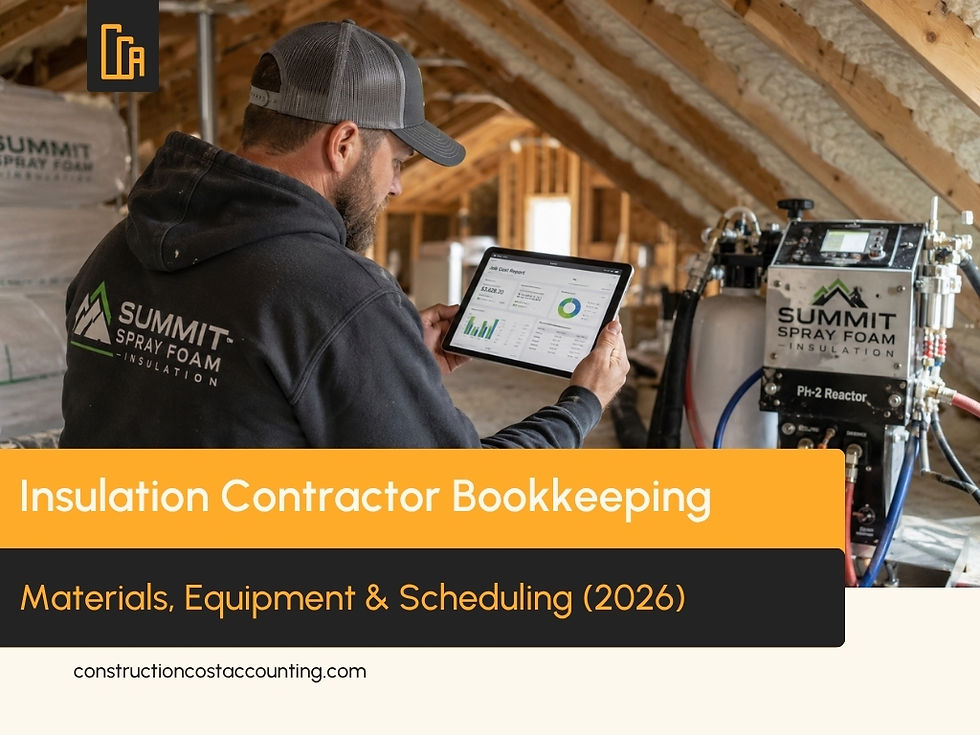
Batt, blown-in, and spray foam insulation aren't variations on the same job — they're three different cost structures with different equipment, different labor skill, and different install speed. Insulation contractor bookkeeping that treats them as one category will misprice most jobs, and a trade that runs entirely behind framing's schedule adds a layer generic bookkeeping never accounts for.
This guide covers what's genuinely different about construction bookkeeping and insulation bookkeeping for an insulation business: costing by material type, equipment investment, and schedule dependency. If you want construction cost accounting built around how this trade actually works, this is for you.
1. Material Type Is Really Three Different Businesses
Batt insulation is a low-equipment, fast-install product. Blown-in requires specialized blowing equipment. Spray foam requires a chemical rig, trained applicators, and the slowest install of the three — and carries the highest material cost by far. Insulation bookkeeping needs to track cost, labor, and equipment by material type, not as one blended insulation category.
INSULATION TYPE CHANGES THE ENTIRE COST STRUCTURE
Same trade, three very different equipment and labor profiles
Batt / Fiberglass | Lowest material cost, fastest install, lowest equipment investment |
Blown-In / Cellulose | Moderate material cost, requires specialized blowing equipment |
Spray Foam | Highest material cost, requires chemical rig equipment and trained applicators, slowest install |
⚠ RED FLAG: If spray foam, blown-in, and batt jobs all run through one blended cost category, you can't tell whether your spray foam division is actually covering its equipment investment — and you'll keep pricing all three the same way. |
2. Equipment Investment Needs Its Own Cost Line

Spray foam and blown-in equipment represent real capital investment, and that cost needs to be allocated to the jobs that use it — not absorbed into general overhead where every job looks the same regardless of which method was used. Insulation contractor bookkeeping should track equipment cost per job so you know whether your higher-equipment methods are actually earning back their investment.
OWNER'S TAKEAWAY: Track equipment cost per job by method. A spray foam job that looks profitable on labor and materials alone might not be, once the rig's cost is actually allocated to it. |
Do You Know Which Insulation Method Actually Earns Its Keep?
Most insulation contractors blend all methods into one cost category and can't see which one covers its equipment investment. CCA builds bookkeeping that costs by material and method. In a free 30-minute review, we'll show you where your numbers stand.
constructioncostaccounting.com | (949) 889-3283
3. Running on Someone Else's Schedule
Insulation can't start until framing, rough-in electrical, and rough-in plumbing are complete and inspected — which means an insulation contractor's calendar is entirely dependent on other trades finishing on time. Construction bookkeeping for an insulation business needs to track jobs by actual readiness, not the original schedule date, since delays upstream aren't a productivity problem on the insulation side.

An insulation contractor's calendar belongs to framing, electrical, and plumbing. The books that track real job readiness are the ones that tell the truth about capacity. |
4. The Reports an Insulation Contractor Needs
Pulling this together, here's what an insulation company should see every month:
Job cost by material type — batt, blown-in, and spray foam tracked separately against the bid
Equipment cost by job — allocated to the jobs that actually used specialized equipment
Schedule readiness tracking — jobs tracked by actual start-readiness, not original date
Financial statements — P&L and balance sheet on a set schedule each month
With those in place, an insulation contractor knows which material type actually drives profit and can plan capacity around real readiness. That's construction accounting doing its job for a trade with three cost structures under one name.
Where Construction Cost Accounting Fits In

Construction Cost Accounting provides construction bookkeeping services and construction accounting and insulation bookkeeping for trades where material type changes the entire cost structure. For an insulation contractor, that means:
Cost tracked by material type — batt, blown-in, and spray foam never blended together
Equipment cost allocated to jobs — so you know which methods actually earn back their investment
Schedule risk understood — jobs tracked by real readiness, not the original framing timeline
A construction bookkeeper who knows insulation — insulation contractor bookkeeping built for the trade's material mix
We work with insulation contractors who need material cost, equipment investment, and schedule tracking all handled with real precision. Our construction bookkeeper team — backed by construction bookkeeping services and construction accounting — keeps every job's true cost visible by material type — so you always know which methods and jobs actually make money. That's results-based construction bookkeeping for insulation contractors.
Know Your True Margin by Insulation Method
CCA builds insulation contractor bookkeeping around material-specific costing, equipment allocation, and schedule tracking. Book a free 30-minute review and see where your books stand.
constructioncostaccounting.com | (949) 889-3283
Insulation contractor bookkeeping has to reflect what the trade actually is: three different cost structures under one name, real equipment investment that needs allocating, and a schedule dependent on other trades. Track cost and equipment by material type, and plan capacity around real job readiness.
The insulation companies that stay profitable aren't guessing at margin by material — they're the ones whose construction bookkeeping services show them exactly which method and job actually makes money. For our full service, visit our construction bookkeeping page. CCA's construction bookkeeper team gives insulation contractors that foundation. Good bookkeeping for an insulation contractor starts with tracking cost by material, not by trade.


Comments