Painting Contractor Bookkeeping: Crew Production, Materials & Commercial vs Residential (2026)

By Tammy Hoang, QuickBooks ProAdvisor — Construction Bookkeeping Specialist | Construction Cost Accounting
(949) 889-3283 | constructioncostaccounting.com

A painting business is a labor business first and a materials business second — paint and supplies are real costs, but crew productivity is what actually decides whether a job makes money. Painting contractor bookkeeping has to be built around production rate, not just materials markup, or a company can be fully booked and still thin on margin.
This guide covers what's genuinely different about construction bookkeeping and painting bookkeeping for a painting business: tracking crew production, separating commercial and residential revenue, and pricing rework and warranty correctly. If you want construction cost accounting built around how painting actually works, this is for you.
1. Crew Production: The Real Margin Driver
The single most useful number in painting contractor bookkeeping is square feet painted per crew per day, compared against what the bid assumed. Paint and materials are a real cost, but they're usually a small share of the job compared to labor — which means a crew that runs slower than bid is the single biggest margin risk on almost every job.
OWNER'S TAKEAWAY: Track actual production rate — square feet per crew per day — against what the bid assumed, on every job. A job that looks fine on the estimate can lose money entirely to a crew running behind, and you only catch it if you're measuring production, not just tracking hours worked. |
2. Commercial vs. Residential: Two Different Businesses
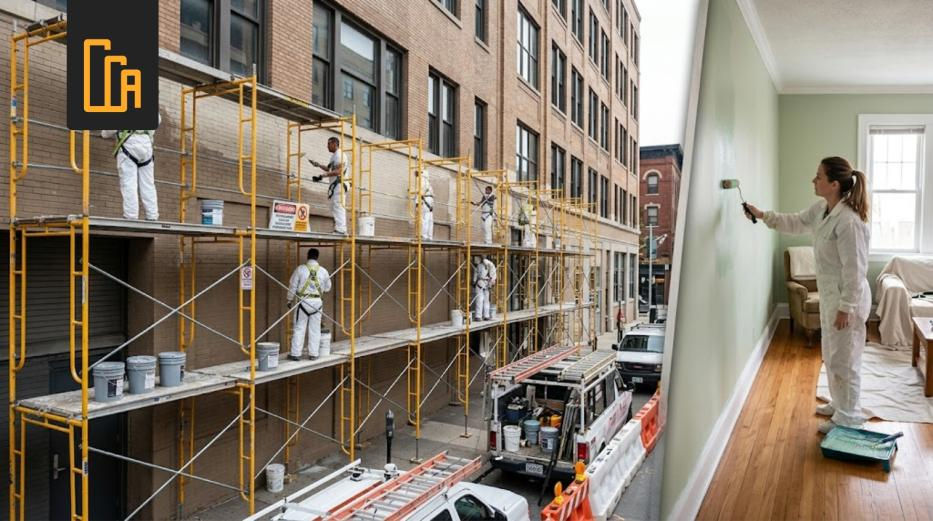
Commercial painting jobs are larger, slower-paying, and won on volume and crew efficiency. Residential jobs are smaller, faster-paying, and less price-sensitive per job. Painting bookkeeping that blends both into one revenue number hides which side is actually driving profit — and that's exactly the number an owner needs before deciding where to grow.
COMMERCIAL vs RESIDENTIAL — TWO REVENUE MODELS
Same trade, different customer, different cash flow
| Commercial | Residential |
Who calls it in | A builder or GC, tied to a construction schedule | A homeowner or property manager, tied to their own timeline |
Job size | Often large — whole buildings, many units | Smaller — rooms, exteriors, single units |
Payment pace | Slower — progress billing, retainage common | Faster — paid on completion, often immediately |
Margin driver | Volume and crew efficiency at scale | Price per job, less competition on small jobs |
Production metric | Square feet painted per crew per day | Jobs completed per week |
⚠ RED FLAG: If commercial and residential revenue are blended into one number, you can't tell which side of the business actually drives profit — and you'll keep chasing volume on the side that pays slower and thinner. |
Do You Know Which Side of Your Business Actually Makes Money?
Most painting contractors blend commercial and residential revenue and lose sight of which side drives real profit. CCA builds painting contractor bookkeeping that separates the two. In a free 30-minute review, we'll show you where your numbers stand.
constructioncostaccounting.com | (949) 889-3283
3. Materials: Waste, Markup & Job-Level Tracking
Paint, primer, and supplies need to be coded to the specific job, not a general materials account — jobs vary widely in how much material they actually consume relative to the bid, and only job-level tracking shows you which jobs are running over. Material markup, where charged, should also be tracked against actual job cost so you can see whether you're actually capturing it or giving it away.
Paint is cheap compared to labor. The real cost of a painting job is the crew's time — and the books that only track material miss the number that actually decides the job's margin. |
4. Warranty & Rework: Tracking the Cost of Callbacks

Peeling, uneven coverage, and color issues generate rework, and that cost needs to trace back to the original job, not a general expense line. Construction bookkeeping that tracks rework by job and by crew reveals patterns — a specific crew, a specific paint line, or a specific prep step that's generating disproportionate callbacks — information you can actually act on.
5. The Reports a Painting Contractor Needs
Pulling this together, here's what a painting company should see every month:
Production report — square feet per crew per day, against the bid, by job
Commercial vs. residential revenue — tracked separately, showing which side actually drives profit
Material cost by job — actual paint and supply cost against the bid
Rework & warranty tracking — callback cost traced to the job and crew that caused it
Financial statements — P&L and balance sheet on a set schedule each month
With those in place, a painting contractor knows which crews and which side of the business actually drive profit. That's construction accounting doing its job for a trade where labor, not materials, decides the margin.
Where Construction Cost Accounting Fits In

Construction Cost Accounting provides construction bookkeeping services and construction accounting and painting bookkeeping for labor-driven trades where production, not materials, decides margin. For a painting contractor, that means:
Crew production tracked — square feet per day against the bid, by job
Commercial and residential separated — real margin visibility on both sides of the business
Material cost tracked by job — not blended into a general expense account
Rework traced to job and crew — so patterns are visible before they repeat
A construction bookkeeper who knows painting — painting contractor bookkeeping built for a labor-first trade
We work with painting contractors who need production, materials, and rework all tracked with real precision. Our construction bookkeeper team — backed by construction bookkeeping services and construction accounting — keeps every job's true cost visible — so you always know which crews and which jobs actually make money. That's results-based construction bookkeeping for painting contractors.
Know Which Crews and Jobs Actually Make Money
CCA builds painting contractor bookkeeping around crew production, job-level materials, and rework tracking. Book a free 30-minute review and see where your books stand.
constructioncostaccounting.com | (949) 889-3283
Painting contractor bookkeeping has to reflect what the trade actually is: a labor-driven business where crew production decides margin more than materials do. Track production by crew, separate commercial from residential revenue, code materials to the job, and trace rework back to its cause.
The painting companies that stay profitable aren't the busiest — they're the ones whose construction bookkeeping services show them exactly which crews and jobs actually make money. For our full service, visit our construction bookkeeping page. CCA's construction bookkeeper team gives painting contractors that foundation. Good bookkeeping for a painting contractor starts with tracking production, not just paint.


Comments