Job Costing for Service & Repair: Time & Materials vs. Fixed Bid

Service calls turn into cash drains when untracked hours and surprise parts eat your margins alive. The wrong job costing method, whether time & materials or fixed bid can hide 20-30% losses until jobs close, forcing you to chase payments or cut crew. Mastering these approaches isn't optional; it's how you turn reactive repairs into predictable profits while keeping clients happy and books balanced. The problem isn't just choosing between time & materials and fixed bid. It's knowing when each method protects your margins, how to track costs without drowning in paperwork, and what happens when you guess wrong on a $5,000 repair that becomes a $7,500 nightmare.

Table of Content: |
Why Service & Repair Job Costing Is Different
Service work lives in constant uncertainty. That "simple" HVAC repair reveals hidden damage requiring three extra hours and $800 in parts you didn’t quote. Emergency calls happen at 2 AM with no time for proper estimates. Site conditions change between your walkthrough and actual work. This unpredictability makes job costing critical and complex. Unlike new construction with detailed plans, service divisions deal with diagnostic work, variable conditions, and clients expecting immediate pricing. Get your costing method wrong, and you're either losing 20% on every job or losing clients who think you're overcharging. The target for service work: 30-40% gross margins. Most contractors achieving this track costs religiously and choose the right billing method for each job type. Those struggling? They're mixing methods without proper accounting, leading to disputes, cash gaps, and invisible profit leaks.
Time & Materials: Billing What You Actually Use
Time & materials (T&M) job costing bills clients for actual labor hours at predetermined rates plus materials with markup. You track hours in real-time, document parts as purchased, and invoice based on what the job actually consumed. Revenue gets recognized as costs incur, making it ideal for diagnostic work or projects with unknown scopes.
Example: An emergency HVAC repair: Your tech spends 6 hours diagnosing and fixing the issue at $125/hour labor rate, totaling $750. Parts cost $450, marked up 20% to $540. Total invoice: $1,290. Actual expenses: $1,042 (labor: $792, parts: $450). Profit: $248 (19% margin).
Why Contractors Choose T&M:
T&M’s flexibility handles scope changes without renegotiating contracts. When that HVAC repair reveals additional ductwork damage, you simply track the extra hours and materials, no change order battles. Risk stays with the client; if problems exceed estimates, they pay for actual work performed. Cash flow stays healthy through progressive billing as work progresses.
Documentation protects margins. Mobile apps capture hours immediately, photos prove conditions, and parts receipts justify every dollar billed. This transparency prevents disputes and ensures you're paid for every hour and part.
Where T&M Fails:
Clients hate unpredictable totals. That emergency repair they hoped would cost $800 balloons to $1,500, creating tension even when the work was necessary. Meticulous tracking becomes mandatory miss logging 30 minutes here and $50 in parts there, and you've donated 10% of your margin. Profit potential gets capped by hourly rates; efficiency doesn't reward you since faster work means less billing. Administrative burden increases too. Every job requires detailed time logs, material receipts, client approvals for additional work, and itemized invoices. For high-volume service divisions, this paperwork becomes overwhelming without proper systems.
Fixed Bid: The Price Is the Price
Fixed bid job costing quotes a lump sum upfront based on estimates, historical data, and padding for unknowns. You track actual costs against budget, but variances hit your bottom line not the client's. Revenue recognition happens via percentage-of-completion or at milestones, requiring more sophisticated accounting.
Example: A plumbing upgrade: You quote $2,500 fixed price, estimating $2,000 in costs ($1,200 labor, $800 materials). Actual costs: $2,100$100 over budget due to longer labor. Final profit: $400 (16% margin), instead of 20%.
Why Contractors Choose Fixed Bid:
Price certainty builds client trust and closes sales. Commercial clients especially prefer knowing exact costs for budgeting and approvals. Higher profits become possible when you beat estimates through efficiency finish that plumbing job in 10 hours instead of 12, and you pocket the savings. Simpler accounting for defined, repeatable jobs where historical data exists. Fixed pricing also encourages operational efficiency. Your crews know the budget and work to hit targets. Standardized processes reduce waste, improving scheduling. For competitive bidding situations, fixed prices often win over open-ended T&M quotes.
Where Fixed Bid Fails:
You absorb overruns and unexpected conditions. A plumbing upgrade revealing corroded pipes behind walls? Your problem, your cost, your margin erosion. Inaccurate estimates can turn profitable jobs into losses fast, underestimate labor by 20%, and your 20% margin disappears completely. Change orders become necessary but contentious. Clients argue about what's truly "extra" versus what should've been included in the original scope. Payment delays while negotiating changes disrupt cash flow. Less flexibility means you're locked into prices even when site conditions are worse than expected during the walkthrough.
When Each Method Protects Your Profits
Use Time & Materials When:
Scope remains uncertain until work begins, like diagnostic service calls where the problem isn't clear upfront.
Emergency repairs requiring immediate response without time for detailed estimates.
Jobs with no historical data to guide accurate fixed pricing.
Clients understand and accept variable costs.
Short-duration work where tracking is manageable and overhead costs are proportionally lower.
Use Fixed Bid When:
Repairs are well-defined with clear scopes, like replacing a water heater or installing a standard AC unit.
You have reliable historical data from similar jobs.
Competitive bidding situations where clients compare multiple quotes.
Repeat clients trust your pricing and processes.
Longer-term service contracts where establishing fixed rates simplifies ongoing work.
Hybrid Approaches: Combine fixed bid for the known base scope with T&M for unknowns. Example: Fixed $3,500 for electrical panel upgrade, plus T&M for any hidden wire damage discovered during work. This balances predictability with flexibility, protecting both parties from extreme uncertainty while maintaining trust.
The Key: Match the method to job characteristics and client relationships. Forcing fixed pricing on uncertain work guarantees losses. Billing T&M for routine, predictable repairs frustrates clients and loses competitive bids.
Your 5-Step Implementation System
Assess Every Job's Scope and Select Method:
Review site conditions during walkthroughs. Check historical data from similar jobs. Evaluate uncertainty level and client preferences. Make deliberate method selection before quoting, don’t default to habit.
Set Up Real-Time Tracking Systems:
Implement mobile apps for immediate time and material logging. Train field teams on documentation requirements. Establish daily review processes to catch errors quickly. No tracking system means no accurate job costing.
Define Rates and Contract Terms Clearly:
Calculate loaded labor rates including burden, overhead, and profit margin. Establish material markup percentages (typically 15-25%). Include change order processes in contracts. For T&M, add not-to-exceed clauses when possible to ease client concerns.
Monitor Progress and Variances:
Compare actual costs to estimates or budgets continuously. Flag variances exceeding 10% immediately. Communicate with clients proactively when T&M jobs are tracking high. Adjust field operations when fixed bid jobs are over budget.
Conduct Post-Job Reviews:
Analyze final margins against projections. Identify what drove variances labor productivity, material costs, scope changes. Refine future estimates based on actual results. Build a historical database for better future pricing.
Critical Mistakes That Kill Service Margins
Inaccurate Time Tracking: Leads to 20% underbilling when techs forget to log hours or round down generously.
Ignoring Overhead Allocation: Makes jobs look profitable while the division loses money, your $75/hour tech costs $105/hour fully loaded.
Poor Change Order Management: Creates unbillable work when scope grows but documentation doesn’t support billing.
Using Outdated Rates: Erodes profits as labor and material costs increase but your pricing doesn't adjust.
Skipping Documentation: Causes disputes and lost revenue when clients question invoices without proof.
Mixing Methods Without Separation in Accounting: Makes true job profitability impossible to determine.
Failing to Train Field Teams: Creates data gaps that destroy job costing accuracy.
Tools That Make Job Costing Work
Modern job costing requires mobile time entry for immediate capture, inventory tracking for materials, automated variance reports, and integration with accounting systems.
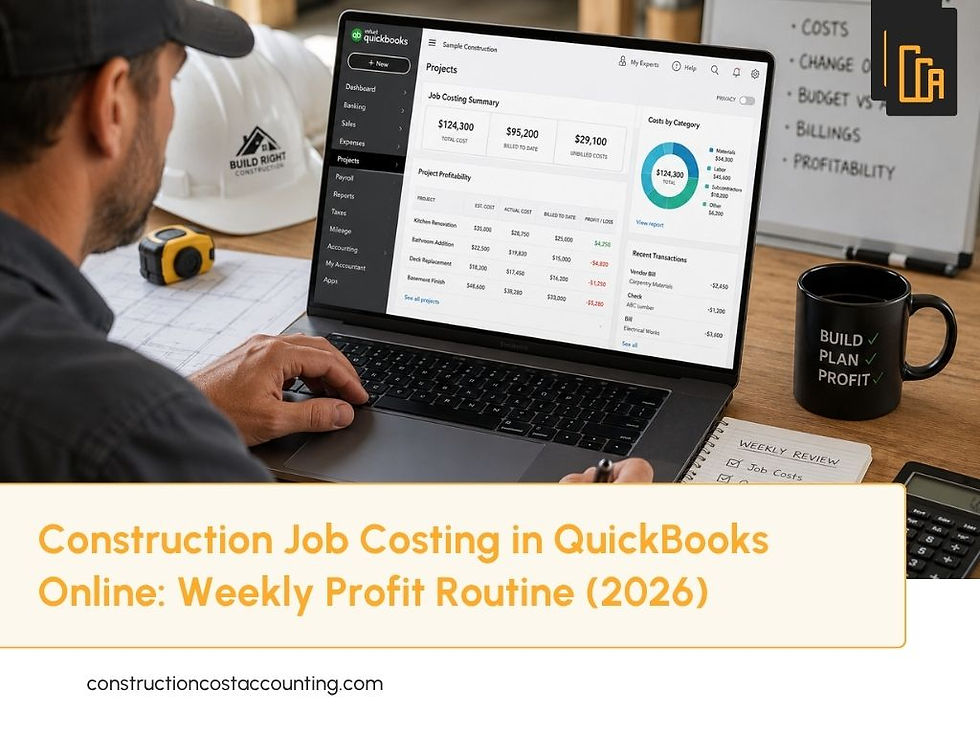
QuickBooks: handles basic job costing for smaller operations.
Procore: scales for larger divisions with complex projects.
Knowify: targets service contractors specifically with field-friendly mobile apps.
Manual Alternative: For small shops, spreadsheet templates work for daily labor hours, material purchases, and job-specific costs, with weekly reconciliations.
The tool matters less than the discipline. Consistent, accurate, immediate tracking beats sophisticated software that nobody uses properly.
Turn Service Calls Into Predictable Profits
Choosing between time & materials and fixed bid job costing determines whether service work generates consistent profits or hidden losses. T&M protects you on uncertain work but requires meticulous tracking. Fixed bid rewards efficiency but punishes bad estimates. Match the method to job characteristics. Track costs religiously regardless of method chosen. Review results to improve future pricing. These fundamentals separate 35% margin service divisions from those struggling at 15%. Start by auditing your last 20 service jobs. Calculate actual margins. Identify which costing method was used and whether it was appropriate. Find patterns in your profitable versus losing jobs.
Construction Cost Accounting specializes in service division job costing systems that work in the field, not just the office. Our job costing audit identifies where margins are leaking and which method fits your work mix. Schedule a free consultation to stop guessing and start knowing your true service profitability.



Comments