Florida Save Our Homes Cap: Bookkeeping for Remodelers, Flippers & Developers (2026)

By Tammy Hoang, QuickBooks ProAdvisor — Construction Bookkeeping Specialist | Construction Cost Accounting
(949) 889-3283 | constructioncostaccounting.com

Florida's Save Our Homes cap limits how much a homestead property's assessed value can rise each year — but that cap resets entirely when a property sells, and new construction or major improvement value is generally added at market value, separate from the capped base. For remodelers, flippers, and developers working on Florida residential property, construction bookkeeping should account for these dynamics in project planning.
This guide covers how Save Our Homes affects renovation and resale projects, and what construction cost accounting should track for it. This is general information — confirm specific assessment implications with the county property appraiser and a CPA.
1. What Save Our Homes Actually Does

Enacted as a 1992 constitutional amendment and effective in 1995, Save Our Homes limits annual assessed value increases on a Florida homestead property to the lesser of 3% or the inflation rate. Non-homestead property — including rental and investment properties — is capped differently. Critically, the accumulated cap benefit does not transfer with a property when it sells.
FLORIDA'S SAVE OUR HOMES CAP — WHAT DEVELOPERS AND REMODELERS SHOULD UNDERSTAND
Confirm current caps and reset mechanics with the county property appraiser
Homestead cap | Assessed value on a primary residence can increase no more than the lesser of 3% or the inflation rate each year, under Florida Constitution Article VII, Section 4(c) |
Non-homestead cap | Rental, investment, and business properties are capped differently, at a higher annual percentage than homestead property |
The cap reset on sale | When a property sells, its assessed value resets to full market value for the new owner the following year — the accumulated cap benefit does not transfer with the property |
New construction value | Value added by new construction or major improvements is generally added to the assessment roll at market value, separate from the capped base |
⚠ RED FLAG: A buyer purchasing a long-held Florida home should expect their property tax to reset to current market value the year after purchase, regardless of what the seller was paying under an accumulated Save Our Homes cap. This 'cap reset' can mean a significantly higher tax bill than the prior owner's, which matters for anyone advising on or planning around a resale. |
2. Renovation Value and the Assessment Roll

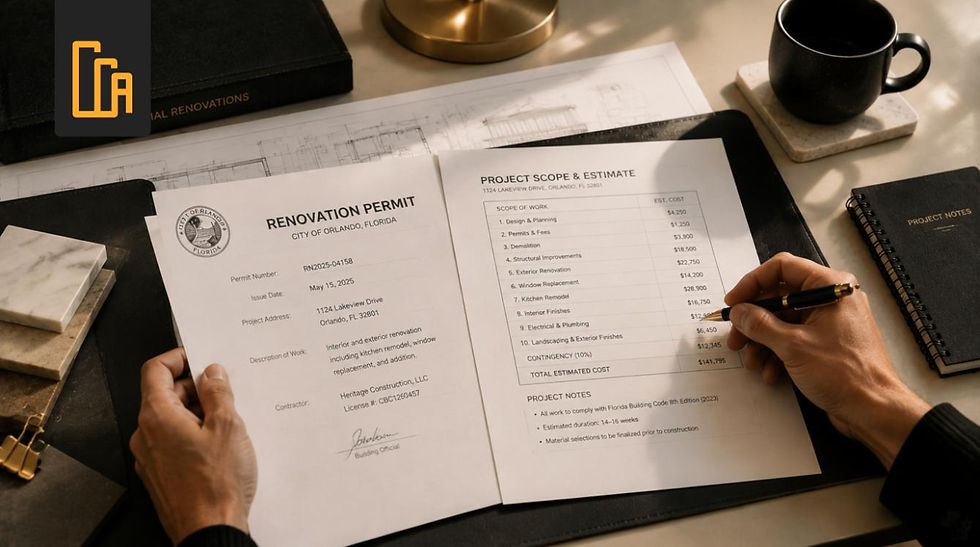
Value added by new construction or a major addition is generally added to a property's assessment roll at market value, outside the capped base value. Construction bookkeeping for a Florida remodeling or spec-building project should track project scope and permit value clearly, since this documentation feeds directly into how the county property appraiser adds the improvement's value to the roll.
OWNER'S TAKEAWAY: Keep clean, permit-matched documentation of exactly what scope of work was completed and its value on every Florida renovation project. This record is what the property appraiser's office references when determining how much of the improvement's value gets added to the assessment roll. |
Is Your Project Documentation Ready for Assessment Purposes?
Many Florida remodeling contractors don't keep permit-matched project value documentation clean enough to be useful after the job. CCA builds bookkeeping that tracks it properly. In a free 30-minute review, we'll show you where your records stand.
constructioncostaccounting.com | (949) 889-3283
3. What This Means for Flippers and Spec Builders
A flipper or developer who buys a long-held Florida homestead property to renovate and resell is buying into a property whose assessed value will reset to market value for the next owner regardless of the seller's prior tax history. Construction cost accounting for this kind of project should model the buyer's likely post-sale property tax reality into marketing and disclosure planning, since it's a real factor in the resale's overall value proposition.
The seller's low tax bill under Save Our Homes tells the next owner nothing about what they'll actually pay. A flipper or spec builder marketing a renovated Florida home should understand that reset is coming for the buyer, and plan the disclosure accordingly. |
4. The Reports a Florida Remodeler or Developer Needs
Pulling this together, here's what a Florida-based remodeler, flipper, or developer should track:
Permit-matched project value documentation — clean records supporting accurate assessment of improvement value
Post-sale tax reset awareness — factored into resale marketing and disclosure planning
Job cost reports — actual cost versus bid, by job
Financial statements — P&L and balance sheet on a set schedule each month
With those in place, a Florida remodeler or developer documents project value accurately and understands the real tax dynamics a buyer will face. That's construction accounting doing its job for a state with a genuinely distinctive homestead assessment structure.
Where Construction Cost Accounting Fits In

Construction Cost Accounting provides construction bookkeeping services for remodelers, flippers, and developers navigating Florida's Save Our Homes structure. For this kind of work, that means:
Permit-matched value documentation — clean records supporting accurate assessment roll additions
Resale tax reset factored into planning — realistic buyer tax expectations built into project economics
Job costing built on clean data — one disciplined system serving both compliance and profitability tracking
A construction bookkeeper who knows Florida — construction bookkeeping services built for the state's real assessment structure
We work with remodelers, flippers, and developers throughout Florida who need renovation value and resale tax dynamics tracked with real precision. Our construction bookkeeper team — experienced in construction accounting for Florida remodeling and resale projects — keeps project documentation and cost data accurate — so every project accounts for the real assessment reality. That's results-based construction bookkeeping for Florida remodelers and developers.
Plan Renovation and Resale Projects Around Real Assessment Rules
CCA builds construction bookkeeping for Florida remodelers and developers around permit-matched documentation and resale tax planning. Book a free 30-minute review and see where your books stand.
constructioncostaccounting.com | (949) 889-3283
Florida's Save Our Homes cap is a genuinely distinctive structure — it protects long-term homestead owners from rapid assessment increases, but resets entirely on sale and doesn't apply the same way to new construction value. Keep permit-matched project documentation clean, factor the post-sale tax reset into resale planning, and confirm specific assessment implications with the county property appraiser.
The Florida remodelers and developers who plan projects accurately aren't ignoring the assessment reset a buyer will face — they're the ones whose construction bookkeeping services account for the real structure. For our full service, visit our construction bookkeeping page. CCA's construction bookkeeper team and construction accounting expertise give Florida remodelers that foundation. Good bookkeeping for a Florida remodeler starts with documenting project value the way the assessment system actually works.


Comments