Electrical Permits & Inspections 2026: The Hidden Job Cost Most Electricians Never Track
- Cost Construction Accounting

- Jun 23
- 8 min read
By Tammy Hoang, QuickBooks ProAdvisor — Construction Bookkeeping Specialist | Construction Cost Accounting
(949) 889-3283 | constructioncostaccounting.com

Electrical work runs on permits and inspections more than almost any other trade. Pull the panel, you need a permit. Add circuits, run a new service, do a tenant improvement — permit, then inspection, sometimes several. It's a constant, unavoidable part of the business. And yet electrical permit cost tracking is one of the most overlooked corners of most electricians' books. Permit fees get dumped into a single 'Permits' expense, the time behind them never gets counted, and when an inspection fails, the re-inspection fee and the rework just disappear into the noise. It's a hidden job cost, and it quietly eats margin.
This is the final guide in our electrician bookkeeping series, and it's about a cost almost nobody tracks properly — written for electrical contractor owners, not accountants. We'll cover why the real cost of a permit is far more than the fee, why electrical inspection costs (especially failed ones) are a hidden margin leak, how to cost permits and inspections to the right job, and what good electrical business bookkeeping does with that information. This builds on our electrician bookkeeping guide → [link to: /post/electrical-contractor-bookkeeping-2026-guide], which covered separating service from project work.
If you've ever had a string of failed inspections on a job and felt the margin slip away without being able to point to where, this guide is for you. As a construction bookkeeper team that handles bookkeeping for electricians, our goal is to turn permits and inspections from a blind cost into a tracked one.
The Real Cost of a Permit Isn't Just the Fee
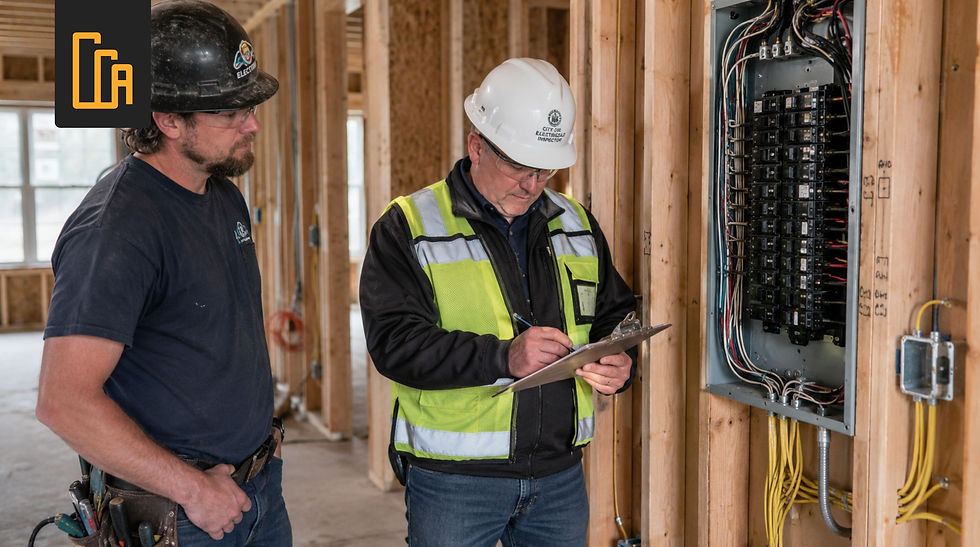
When most electricians think about permit cost, they think about the fee — the check to the building department. That's the visible part, and often the smallest. The real cost of permits and inspections has several layers, and construction cost tracking that only captures the fee misses most of it. Here's what a permit actually costs you:
THE REAL COST OF A PERMIT ISN'T JUST THE FEE
Most electricians track the fee and miss everything else that permits and inspections actually cost
The permit fee | The obvious cost — the check you write to the building department. Often the smallest piece. |
Pull-and-file time | Office time filling out the application, submitting, and managing the permit. Real labor, rarely tracked. |
Inspection scheduling & wait | Coordinating the inspector, and crew downtime if work can't proceed until the inspection passes. |
Re-inspection fees | When an inspection fails, you pay again — and sometimes again. Pure margin loss. |
Rework labor | The crew time to fix what failed and the return trips. Often the biggest hidden cost of all. |
Source: Construction Cost Accounting | constructioncostaccounting.com
Track only the fee, and you're seeing a fraction of what compliance actually costs you — job by job.
Add those layers up and a 'small' permit can carry real cost — especially when you count office time to pull and file it, crew downtime waiting on inspections, and the labor to fix and re-present anything that fails. For an electrical contractor doing dozens or hundreds of permitted jobs a year, that's not a rounding error. It's a meaningful slice of margin that, tracked properly, you can actually manage. Good electrical permit cost tracking captures all the layers, not just the fee.
FROM THE OWNER'S CHAIR: When an electrical contractor says a permitted job 'cost about the permit fee,' that's the tell. The fee is the small part. The expensive parts are the office time to handle the permit and the crew time lost to inspections and any rework. Those are real costs that good electrical contractor accounting captures — they're just rarely written down anywhere a job costing report can see them. |
Failed Inspections: The Margin Leak Nobody Logs
Of all the electrical inspection costs on a job, the most damaging — and most invisible — is the failed inspection. When an inspection fails, three things happen, and most books capture none of them:
You pay a re-inspection fee — a direct cash cost to have the inspector come back, which usually lands in the lump 'Permits' expense with no link to the job
Your crew does rework — labor to fix what failed, which often gets buried in general job labor with no flag that it was rework, not original scope
The job stalls — work that can't proceed until the re-inspection passes, creating downtime and schedule slippage that ripples to other jobs
Here's why this matters so much for electrical contractor job costing: a job can fail two or three inspections, rack up re-inspection fees and rework labor, and still look 'fine' on the books — because none of that extra cost was tagged as failed-inspection cost. This is a blind spot in job costing for electricians that lump-expense bookkeeping creates. The margin is gone, but the report doesn't show why. Track it, and a pattern emerges: maybe one crew fails inspections more often, or one type of work, or one jurisdiction is stricter. That's information you can act on. Untracked, it's just margin that mysteriously isn't there.
⚠ RED FLAG: A failed inspection is rarely a one-time accident. If your books don't separate re-inspection fees and rework labor, you can't see whether failed inspections are a recurring drain — tied to a particular crew, a particular type of job, or a documentation gap. The cost stays invisible, so the root cause never gets fixed, and it keeps happening. |
Permit Fees Disappearing Into a Lump Expense?
When permit and inspection fees get dumped into one 'Permits' expense instead of costed to the jobs that incurred them, your job costing is wrong and re-inspection costs hide in plain sight. CCA sets up electrical contractor bookkeeping that costs permits and inspections to the right job. In a 30-minute call, we'll review how your books handle permit and inspection costs today.
Call or Text: (949) 889-3283
Cost Permits and Inspections to the Right Job

The fix is the same principle that runs through all good job costing for electricians: every cost should land on the job that incurred it. Permits and inspections are no exception. Instead of one company-wide 'Permits' expense, each permit fee, inspection cost, and re-inspection fee gets costed to the specific job it belongs to. Here's what that looks like in practice:
TWO WAYS TO HANDLE PERMIT & INSPECTION COSTS
One hides your real job cost. The other tells you the truth.
✗ DUMP IN 'PERMITS' EXPENSE | ✓ COST IT TO THE JOB |
Every permit fee, inspection, and re-inspection goes to one company-wide 'Permits' expense. You never see what compliance cost on any specific job. Failed inspections and re-inspection fees vanish into the lump — invisible margin loss. | Each permit, inspection, and re-inspection is costed to the job that incurred it. Every job carries its real compliance cost. You can see which job types and which jurisdictions cost you most — and spot a failed-inspection problem early. |
Source: Construction Cost Accounting | constructioncostaccounting.com
Same fees, same inspections. The right way turns a blind cost into a tracked one you can manage and bid for.
With permit fees job costing done this way, your job costing reports finally carry the full cost of compliance. This is construction cost tracking applied to a cost most electricians leave untracked. You can see which job types are permit-heavy, which jurisdictions cost you the most in fees and delays, and — critically — which jobs got hit with failed-inspection costs. That last one is the difference between a job that looks profitable and one that actually is. And you don't need to track every minute: the high-value move is costing the fees and re-inspection charges to the job, and flagging rework labor when it happens.
OWNER'S TAKEAWAY: You don't need a complicated system. The 80/20 for permits: code every permit fee, inspection cost, and re-inspection fee to the specific job instead of a lump 'Permits' account, and flag rework hours when an inspection fails. That alone makes your job costing honest and surfaces failed-inspection patterns you can fix. It's a small setup change with a real payoff. |
What Tracking Permits and Inspections Shows You
Once permits and inspections are costed to jobs, your electrical contractor job costing can answer questions that were invisible before. These are the business insights that fall out of tracking what most electricians ignore:
True cost of compliance per job — the full permit-and-inspection cost on each job, so 'profitable' actually accounts for it
Failed-inspection patterns — whether re-inspections cluster around a crew, a job type, or a jurisdiction, so you can fix the root cause
Jurisdiction cost differences — which cities and counties cost you more in fees and inspection delays, useful for bidding work in those areas
Better estimates — real permit-and-inspection cost data so you build accurate compliance costs into future bids instead of guessing
Rework visibility — how much labor is going to fixing failed inspections versus original scope, a number most electricians never see
None of this requires an accounting background — it requires electrical contractor accounting set up so permits and inspections are costed to jobs instead of dumped in a lump. With that in place, a cost most electricians treat as unavoidable overhead becomes a tracked, manageable, even improvable part of the business. You can't reduce a cost you can't see.
Permits and inspections are unavoidable. The margin they quietly eat is not. The difference is whether your books cost them to the job — or let them hide in a lump nobody looks at. |
Where Construction Cost Accounting Fits In For You

Construction Cost Accounting provides construction bookkeeping services built for electrical contractors — including the permit-and-inspection cost tracking most generalist bookkeepers never set up. We're a QuickBooks ProAdvisor practice, and here's what electrical contractor owners get from us on the compliance-cost side:
Permits and inspections costed to jobs — fees, inspection costs, and re-inspection charges landing on the jobs that incurred them
Failed-inspection visibility — re-inspection fees and rework flagged, so you can see and fix recurring patterns
True compliance cost per job — so 'profitable' jobs account for the full cost of permits and inspections
Jurisdiction cost data — which cities and counties cost you most, useful for bidding
Estimate-ready data — real permit-and-inspection cost history so you bid compliance accurately
A construction bookkeeper who knows electrical — trade-specific bookkeeping for electricians, not a generalist dumping permits in a lump account
Most electrical contractors we onboard see accurate permit-and-inspection costing within 30 days. Our construction bookkeeper team sets up the cost tracking and runs the monthly work, so your jobs carry their true compliance cost and failed-inspection drains stop hiding. You keep running the work; your books show you the real cost of every permit and inspection. Solid electrician bookkeeping turns an overlooked overhead into a cost you can actually manage.
Want Permits, Inspections & Re-Inspections Costed to the Right Job?
CCA builds electrical contractor bookkeeping that tracks permit fees, inspection costs, and the time behind them to the jobs that incurred them — so your job costing is honest and failed-inspection costs stop hiding. You see the real cost of compliance on every job. Most electrical contractors we onboard see accurate permit-and-inspection costing within 30 days.
Call or Text: (949) 889-3283
In 2026, the electrical contractors with honest job costing track the costs other electricians ignore — and permits and inspections are near the top of that list. Electrical contractor bookkeeping that dumps every permit fee into one lump expense hides the real cost of compliance and lets failed-inspection costs vanish. Electrical permit cost tracking done right — costed to the job, fees and re-inspections and rework all visible — restores the truth to your numbers.
The owners who run tight electrical businesses share one habit: they cost permits and inspections to the jobs that incurred them, and they watch for failed-inspection patterns. The owners who struggle treat it all as unavoidable overhead, never see what compliance really costs per job, and let re-inspection fees and rework quietly drain margin. The difference isn't the permits — it's the electrical business bookkeeping behind them.
Construction Cost Accounting sets up electrician bookkeeping that tracks permits, inspections, and re-inspections to the right jobs, so your job costing is honest and compliance costs stop hiding. Our construction bookkeeping services are built for the trades, and our team knows electrical. This wraps up our electrician bookkeeping series — for the foundation of separating service from project work, see our electrician bookkeeping guide. For reading the reports your books produce, see our job costing reports guide. And for our full construction bookkeeping service.


Comments